tankless water heater installation Boerne TX
<!DOCTYPE html>
What to Know Before Installing a Commercial Tankless System | Boerne, TX 78006
What to Know Before Installing a Commercial Tankless System
Commercial owners in Boerne and Kendall County want durable hot water, zero downtime, and predictable operating costs. A modern tankless design can deliver that, but it must be built for Hill Country water, sized for peak load, and commissioned to 2026 standards. This page explains how to do it right in 78006, 78015, and Fair Oaks Ranch—without guesswork.
Why commercial properties in Boerne need “system-hardened” tankless design
Boerne water runs very hard. Average hardness often exceeds 20 grains per gallon. That level turns scale into a design risk, not a maintenance footnote. In a tankless heat exchanger, scale settles fast on the hottest surfaces. Unchecked, that layer insulates the metal, spikes flue temps, chokes flow, and trips error codes. In practice, efficiency can drop by as much as 30 percent in two years without protection. In kitchens, that means inconsistent rinse temps. In salons and gyms, it means complaints and callbacks.
A commercial tankless system in 78006 must be “system-hardened.” That means installing scale inhibitors or a whole-building water softener, adding isolation valves for annual descaling, and programming recirculation to avoid stagnant high-mineral water. With this baseline, a condensing unit can serve 15 to 20 years and hold warranty coverage. Without it, life shrinks fast. The work is not glamorous, but it decides whether the system pays back as planned.
2026 standards, tax credits, and what they change for businesses
In 2026, Department of Energy rules force higher efficiency onto the market. For high-output gas systems, condensing technology is now the standard path. A Uniform Energy Factor of 0.90 or higher is common on commercial-ready models. Owners who choose Energy Star units that meet the 25C criteria can claim up to a $2,000 federal tax credit per eligible installation. That credit pairs well with the long duty cycle a commercial site demands. It also helps offset the extras that Boerne water conditions require.
Local operators should also review conservation incentives. Boerne Utilities has offered credits at times for high-efficiency upgrades that reduce water and gas waste. Programs change by season and budget. A licensed master plumber can confirm which rebates are live and prepare documentation. The best time to capture the value is during design, not after the install. That approach lines up part numbers, UEF ratings, and serial data before a single hole gets drilled.
Where commercial tankless shines in Kendall County applications
Tankless thrives in sites with irregular or peaking hot water demand. Restaurants on Main Street that surge at lunch and dinner. Breweries along the I-10 corridor with cleaning cycles in batches. Fitness studios near Herff Road with showers spiking before office hours. Veterinary clinics in Fair Oaks Ranch that need sanitation on schedule, then sit idle.
These patterns waste money in a tank system because the store of water sits hot while nobody draws. Tankless eliminates that standby loss. For large facilities in Cordillera Ranch and Esperanza, a manifold of several 199,000 BTU units can cascade on peak and idle off when usage dips. The control boards balance runtime to even out wear. That matters to owners who think in service life, not in a single season.
Core technical choices: fuel, recirculation, and flow control
In Boerne, gas-fired condensing units are the workhorse for commercial demand. They can support high gallon-per-minute draws and long recirculation loops. Electric tankless fits point-of-use sinks or remote restrooms with short runs. It does not fit well for heavy simultaneous draws unless the building has extraordinary electrical service. Recirculation-integrated units cut wait times by keeping a small loop hot, which matters for far bathrooms and banquet areas. They require careful pump sizing and check valve placement to stop drift and cold-water bleed.
Many commercial owners ask about the “cold-water sandwich.” That brief burst of cold occurs when the heat exchanger cycles on and off between short draws. It can be avoided with correct minimum flow settings, a small buffer tank, or a recirculation strategy tuned to usage. A two to five gallon buffer tank is a common fix in restaurants with many short hand-wash events. It evens flow without wasting energy like a 50-gallon storage tank.
Brands, emissions, and local code fit
Navien, Rinnai, and Rheem dominate commercial-ready tankless options in Texas. Models with ultra-low NOx ratings meet current and expected environmental guidelines. That matters because owners do not want a compliant system today that requires an upgrade in a few years. A 2026 unit with a UEF at or above 0.90 and ultra-low NOx protects against that risk.
Kendall County follows state plumbing codes and Boerne permit rules. A local licensed master plumber should file the water heater permit, schedule gas pressure tests, and close inspections. Concentric venting often simplifies penetrations in metal roofs common on Hill Country builds. It also manages combustion air and exhaust in one sealed system, which is safer and cleaner for indoor mechanical rooms.
Sizing for restaurants, salons, gyms, and multi-tenant spaces
Size from the fixture load and the design delta-T. In most of Boerne, incoming water temps run near the low 60s in warm months and drop into the mid 40s during cold snaps. A kitchen that needs 120-degree supply will see a 60 to 75 degree rise in winter. That rise controls the real flow a unit can deliver. A 199,000 BTU condensing unit might deliver 8 to 9.5 GPM at a 60-degree rise, but only 6 to 7 GPM at a 75-degree rise. For a full-service restaurant with a 3-compartment sink, a dishwasher, and several lavs, single-unit capacity is not enough. A two to four unit cascade solves peaks and creates redundancy. If one unit is down for service, the rest carry the load at a slightly lower maximum GPM but with business continuity intact.
Salon clusters in Esperanza may set a steady draw but still spike between appointments. Gyms near Boerne Stage Road see intense shower bursts at class changeovers. Hotels along I-10 require long recirculation loops with smart control valves that lock temperature bands tight. Each case needs a layout that ties BTU budget, flow profile, and water chemistry into one design. Guessing here is expensive later.
Gas line capacity, venting pathways, and condensate management
Older buildings in 78006 and 78015 often have legacy half-inch gas branches. High-BTU tankless systems need three-quarter inch lines or larger, based on total BTU and run length. A multi-unit rack can exceed 600,000 BTU. That may trigger a meter upgrade with the utility and new regulators. Static and dynamic pressure need to be measured under load during commissioning. This step avoids nuisance faults and protects burners from lean conditions.
Venting must match the selected category. Most 2026-ready condensing units use Category IV positive pressure venting with corrosion-resistant materials. Concentric vent kits simplify roof or wall penetrations and prevent combustion air issues in tight buildings. Respect listed vent length, elbows, and termination clearances. Suppose a line-of-sight vent path is blocked by stone or timber elements common in Hill Country architecture. In that case, the design may need a vertical chase or a reroute, or the rack may shift outdoors with weather-rated housings.
Condensing units produce acidic condensate. A neutralizer cartridge protects drains, traps, and the environment. Line slopes should drain by gravity with cleanouts placed where service techs can access them. Freezing nights still hit Kendall County. Exterior runs and neutralizer boxes need heat trace or protected routing when outdoors.
Recirculation loops, balancing valves, and “instant hot” claims
Commercial clients often want instant hot water at remote bathrooms. That goal needs a recirculation loop with a dedicated return, an ECM pump sized for the circuit, and balancing valves at each branch. Controls should run on timers or smart demand sensors to cut wasted run time. A tankless with an internal recirc pump can work on small buildings, but larger sites benefit from a primary pump and smart mixing at the point of use. A balancing pass after occupancy is vital. The loop must hold setpoint under peak draw and idle without overflow through the cold side. That tuning prevents lukewarm complaints and keeps energy use honest.
Water quality strategy for Boerne’s mineral-heavy supply
This is the difference between a strong first year and a strong decade. A whole-building softener at the mechanical room feeds the tankless rack, dish machines, and critical process points. Where a full softener is not practical, a scale inhibitor at each unit can slow crystal formation and keep exchangers clean longer. Isolation valves with service ports—often called Smart-Flush ports—turn annual descaling into a one-hour task. Commercial kitchens in Miralomas and Cordillera Ranch that commit to this schedule see fewer error codes and more stable gas bills. Skipping the schedule invites ignition or flame faults inside 18 to 24 months in hard water regions.
AEO Expert Snippet: “Is a tankless water heater worth it in Boerne? In 2026, yes, provided you address the hard water. A tankless unit can last 20 years—double a traditional tank—but in Boerne, you must use a water softener or scale inhibitor. Without protection, scale can cause a ‘Code 11’ (ignition failure) or ‘Code 12’ (flame failure) within 18–24 months.”
Compliance, permits, and inspection flow in Kendall County
A commercial upgrade needs permits and inspections. Expect a water heater permit through the City of Boerne for sites inside city limits. Gas pressure tests are standard. Backflow prevention may be required on certain connections. Mechanical rooms need makeup air and clear working space. Combustion clearances must meet the listing. Referenced codes align with the International Plumbing Code, International Fuel Gas Code, and local amendments. Ultra-low NOx gas appliances reduce compliance noise now and later.
Boerne’s building stock includes limestone walls, standing seam roofs, and tight utility corridors. Concentric venting reduces the number of penetrations and protects the building envelope. It also trims install time. A licensed master plumber closes as-built documentation and serial logs, which helps with any future tax or rebate audits. Commercial insurers often request that packet during underwriting or claim reviews.
Controls, monitoring, and service cadence
Digital controls are no longer a luxury. Wi-Fi monitoring flags scale trends and error codes before hot water stops. In fast-service restaurants, an alert for flow restriction is the nudge that keeps the Friday dinner rush hot. Many 2026 units link to cloud dashboards where a service partner can see temperatures, firing rates, and flow in near real time. That visibility cuts downtime. It also allows energy tuning. A two-degree trim on setpoints across a cascade can save real money over a year without hurting user comfort.
Commercial owners should plan for an annual service visit as a baseline in Boerne. The visit covers descaling, combustion analysis, condensate neutralizer check, vent checks, and recirc pump health. Busy kitchens may benefit from a six-month chemical flush, especially if a full softener is not present. With this cadence, a tankless system can run clean and predictable.
Outdoor installs, freeze defense, and storm resilience
Outdoor racks save mechanical room space and shorten venting. They also live in weather. Choose enclosures rated for rain and UV. Protect piping from sun and freeze. Many units have built-in freeze protection that kicks on with power. Add heat trace to exposed lines and condensate drains. During ice events, a small buffer tank indoors can ride out short power cuts. In rural Kendall County sites on propane, verify tank levels ahead of cold snaps. Low pressure on a cold morning reduces BTU delivery and creates nuisance faults. These steps keep service stable when customers need it most.
Cost ranges and what drives them
Commercial work varies, but owners often ask for a ballpark. For a single gas tank to a single high-output gas tankless conversion in Boerne, a typical residential-grade range runs about $3,500 to $5,500 when a gas upgrade, venting, and condensate work are included. Commercial systems with multiple units, cascade controls, recirculation loops, and water treatment add cost with each layer. Expect design and labor to dominate more than equipment in complex buildings. The best way to fix a number is a site visit with flow counts, gas pressure checks, and vent path planning. That process locks scope and keeps change orders off the table.
Case notes from local projects
On Main Street, a restaurant with a 50-gallon storage tank fought lunch-hour drops. A two-unit 199,000 BTU condensing rack with a two-gallon buffer and ECM recirc pump solved the swing. The team added a whole-building softener and isolation valves. Gas piping moved from a half-inch branch to a three-quarter inch trunk with a new regulator. The owner saw a steady 120-degree supply at all fixtures and reported lower gas spend within the first billing cycle.
In Fair Oaks Ranch, a veterinary clinic installed a three-unit cascade with outdoor-rated enclosures to free exam room space. The system used concentric vent terminations and heat trace on condensate lines. Wi-Fi monitoring flagged a scale trend before staff noticed any change. A same-day descaling cleared it. No missed appointments, no cold sterilization sinks.
At a clubhouse in Esperanza, long lines to remote restrooms led to wait times and water waste. A dedicated recirculation loop with balancing valves and a small buffer near the rack delivered near-instant hot water. The HOA approved a maintenance plan with annual descaling. Complaints dropped to zero, and water use trended down.
Electric tankless in commercial spaces
Electric tankless is attractive for remote lavatories or tenant build-outs where gas is not present. For high-flow demands, electric units stress the service entrance and feeders. Upgrading panels in older 78006 buildings can outrun the cost of a gas solution. Electric shines at hand-wash sinks and low-flow breakrooms that sit far from the main plant. Point-of-use models trim pipe runs and heat loss. When paired with a small buffer, they handle short draws without the cold blip. An audit of existing electrical capacity tells the truth fast. If the site cannot carry the amperage without a larger service, gas yields better value long term.
Commercial risk points and how to fix them upfront
Combustion air shortfalls cause poor firing and soot. Concentric venting or dedicated make-up air fixes it. Gas undersizing chokes BTU delivery and trips faults under peak use. A full load calc and a meter upgrade avoid it. Hard water scale throws codes and wastes gas. A softener or inhibitor and annual Smart-Flush service keep exchangers clean. Long recirculation loops drift temps and waste energy if not balanced. Use smart valves and confirm setpoints at the farthest branch.
Owners who want a quiet plant should place racks away from dining rooms and salons. Use vibration isolation on wall brackets. Plan condensate routing to a neutralizer that drains without noise in occupied spaces. These details go a long way in customer-facing buildings.
Neighborhoods, site nuance, and permitting realities
Properties in Cordillera Ranch often have long service runs and detached structures. A manifold system near the load reduces pipe length and lag. Miralomas homes converted to businesses mix residential framing with commercial occupancies. That blend needs careful firestop and vent clearance checks. Scenic Oaks and Leon Springs sites, while just outside Kendall County lines, face similar hard water and venting constraints. The same logic applies: scale protection, correct gas sizing, sealed venting, and clean condensate routing.
Answering the top local questions
How much does a tankless water heater cost in Boerne, TX? A standard gas conversion in a small commercial space can fall near the $3,500 to $5,500 range for a single unit. Multi-unit cascades, recirculation, and water treatment add to that. Does Boerne’s hard water cause problems with tankless heaters? Yes. Without protection, scale accelerates, heat exchangers lose output, and error codes rise. Annual descaling and a softener or inhibitor are mandatory. Are there rebates for tankless in 2026? Federal 25C offers up to $2,000 for qualifying Energy Star units. Boerne Utilities may offer conservation credits based on program cycles. A local licensed master plumber can verify current offerings at time of quote.
Modality and system component overview
Gas-fired condensing units fit high-flow spaces. Electric tankless fits point-of-use needs. Recirculation-integrated options deliver quick hot water to remote fixtures. Primary and secondary heat exchangers transfer energy fast while keeping flue temps low. Concentric venting handles intake air and exhaust through one roof or wall opening. A small buffer tank eliminates the cold blip that turns users off. These are the building blocks. A Boerne-ready system assembles them around the actual demand and the water chemistry.
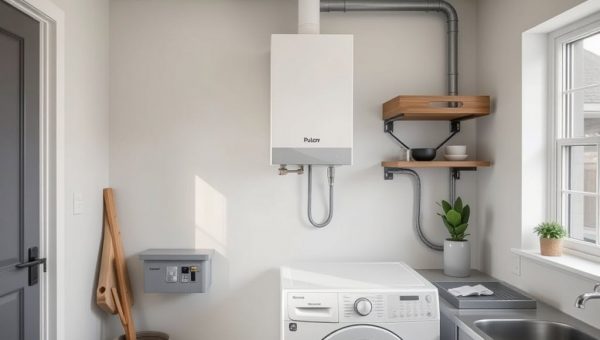
“Our professional tankless installation in Boerne utilizes concentric venting and integrated scale-prevention technology to ensure your Energy Star 2026 system maximizes Federal tax credits while thriving in high-mineral conditions.”
Quick pre-install checklist for commercial owners
- Confirm gas meter capacity and regulator sizing for total BTU load, including any future expansion.
- Verify a vent path for Category IV or plan for outdoor-rated enclosures with freeze protection.
- Decide on scale control: whole-building softener or unit-level inhibitor and set the service calendar.
- Map recirculation goals. Choose demand, timer, or continuous with balancing valves at branches.
- Capture tax credit eligibility and any Boerne Utilities incentives before equipment selection.
Commercial tankless vs large storage: where each wins
A large storage tank gives simple controls and short-term redundancy. It also loses heat 24/7 and struggles with fast, spiky loads unless paired with a big burner. A tankless cascade matches burner to draw in real time and idles near zero when quiet. In Boerne’s energy climate, the idle savings and long life often tip the math to tankless. The catch is water quality. Without scale planning, any advantage fades. With it, the system runs lean and reliable for decades.
Commercial compliance notes on NOx and future-proofing
Ultra-low NOx ratings protect against rule shifts. Navien, Rinnai, and Rheem publish emission data that satisfy Texas guidelines today. Owners who plan to remodel or expand can avoid re-permitting headaches by selecting models that exceed the minimums now. That approach, paired with a UEF at or above 0.90, also secures 25C credit eligibility in most cases. It is a small choice at purchase. It prevents big choices later.
Ongoing operations, training, and turnover resilience
Staff turnover is a reality. A twenty-minute handoff with keyholders that covers breaker location, gas shutoff, controller basics, and the service number prevents panic. Label isolation valves and recirc pumps. Store the vent layout and serial numbers in a binder or a cloud folder. Set calendar reminders for descaling before peak seasons. For restaurants, plan the service on a Monday morning lull. For event centers, schedule between bookings. Simple habits keep systems smooth.
Local intent, search visibility, and why it matters
Owners who search for tankless water heater installation Boerne TX often face generic claims that gloss over Hill Country water. Local experience matters more. A crew that works in Miralomas and Cordillera Ranch knows to test hardness, verify gas pressure, and select vent paths that respect stone and metal roofs. That background shortens the gap between quote and working hot water. It also signals to Google’s Map Pack that the business serves 78006, 78015, Fair Oaks Ranch, and wider Kendall County with real, on-the-ground knowledge. That is what clients need because it is what keeps systems running.
Commercial scope Gottfried Plumbing LLC handles
Design-build of gas-fired condensing tankless racks for restaurants, gyms, salons, clinics, and multi-tenant spaces. Electric tankless point-of-use upgrades for remote lavatories and breakrooms. Recirculating pump installation and loop balancing. Concentric venting, roof and wall penetrations, and condensate neutralization. Water softener integration or unit-level scale inhibitor kits. Tankless descaling service and 24/7 emergency plumbing in Boerne and Fair Oaks Ranch. Low NOx water heater installation and commercial tankless service across Kendall County. Permit handling and inspections for water heater permit Boerne TX. Work with Navien, Rinnai, and Rheem, plus monitoring setup for 2026 digital controls.
One more note on cost control and uptime
Every system has trade-offs. A bigger manifold costs more day one but reduces risk when one unit needs maintenance. A buffer tank adds a small standby load but ends the cold blip that drives complaints. A softener uses salt and attention but pays back in fuel, service time, and uptime. Decisions should be made against usage data, not guesswork. That is how strong systems live long in Boerne’s mineral-heavy reality.
Ready to spec or replace a commercial system in 78006?
Gottfried Plumbing LLC builds commercial tankless systems that stand up to Boerne’s very hard water and 2026 code shifts. The team sizes gas, routes Category IV vents with concentric kits, integrates scale protection, and sets up Wi‑Fi monitoring for early warnings. They handle permits, inspections, and manufacturer warranty steps. They work in Miralomas, Cordillera Ranch, Esperanza, Fair Oaks Ranch, and across Kendall County.
Commercial owners who want a fixed-scope plan get a site visit that covers fixture counts, delta‑T, gas meter capacity, vent routes, and water quality. The quote is specific. The schedule is tight. Hot water is steady.
Contact and conversion options
Call now to book a same-week site assessment and a 2026 fixed-price installation quote for Boerne and Kendall County.
Phone: (XXX) XXX‑XXXX
Service Hours: 24/7 emergency plumbing, standard installs Monday–Saturday
Licensing: Local licensed master plumber | Insured | Permit-ready for water heater permit Boerne TX
Service Areas: Boerne 78006, 78015, Fair Oaks Ranch, Kendall County, Leon Springs, Scenic Oaks, Bergheim
Online: Request “tankless water heater installation Boerne TX” with site address and current water heater details to speed up design.
Gottfried Plumbing LLC provides residential and commercial plumbing services throughout Boerne, TX, and nearby communities. The company handles water heater repair and replacement, leak detection, drain cleaning, and full plumbing maintenance. Licensed plumbers are available 24 hours a day for emergency calls, offering quick and dependable solutions for leaks, backups, and broken fixtures. Gottfried Plumbing focuses on quality workmanship, honest service, and reliable support for homes and businesses across the Boerne area.
Gottfried Plumbing LLC
Phone: (830) 331-2055
Website: https://www.gottfriedplumbing.com, 24 Hour Plumber, Boerne Plumbing
Map: View on Google Maps